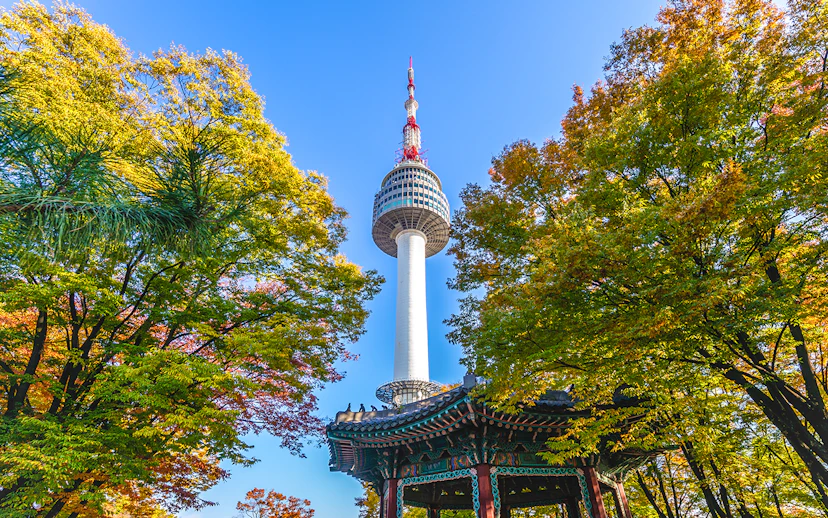
Visiting N Seoul Tower: your complete guide
N Seoul Tower is Seoul’s best-known observation tower, and the visit is as much about timing and approach as it is about the view itself. The tower is straightforward once you’re there, but the full outing often includes a cable car ride, a short uphill walk, crowded sunset windows, and extra time for the Love Locks terrace or dinner. The difference between a smooth visit and a frustrating one usually comes down to when you arrive. This guide covers timing, tickets, access, and how to plan the visit well.
Quick overview: N Seoul Tower at a glance
If you want the shortest version first, these are the details that actually change the visit.
- When to visit: Monday–Sunday: 10am–10:30pm. Weekday mornings or after 8pm feel noticeably calmer than the hour before sunset, because most visitors time both the cable car and observatory for golden-hour photos.
- Getting in: From ₩29,000 for standard observatory entry. Guided tours and combo experiences usually start higher than basic entry, and sunset visits, weekends, and dining packages are worth booking ahead in spring and fall.
- How long to allow: 1–2 hours for most visitors. Add extra time if you’re taking the cable car, lingering for night views, or eating at one of the tower restaurants.
- What most people miss: The outdoor Love Locks terrace and the mountain-facing side of the tower get rushed, because most visitors head straight indoors and stay focused on the brightest city skyline views.
- Is a guide worth it? For the tower alone, usually no — the route is simple and the main payoff is the view — but a guided option makes more sense if you’re pairing it with a wider Seoul sightseeing day.
Jump to what you need
🕒 Where and when to go
🗓️ How much time do you need?
🎟️ Which ticket is right for you?
🗺️ Getting around
🌆 What to see
♿ Facilities and accessibility
Where and when to go
How do you get to N Seoul Tower?
Address: 105 Namsangongwon-gil, Yongsan-gu, Seoul, South Korea
- Subway + cable car: Myeong-dong Station (Line 4) → walk from Exit 3 to the Namsan Outdoor Elevator and cable car station → easiest scenic route.
- Subway + walk: Chungmuro Station (Lines 3 and 4) → walk uphill toward the cable car access area → best if you don’t mind a longer approach.
- Shuttle bus: Namsan Shuttle Bus 02 or 03 → direct access up the mountain loop → easiest low-cost option without the cable car queue.
- Taxi / rideshare: Tower drop-off area → about 200m uphill on foot → easiest if you want to avoid transfers.
Which entrance should you use?
The tower visit is simple once you reach the summit, but the part most visitors get wrong is assuming the cable car ticket also covers the observatory. It doesn’t — the tower admission is separate.
- Pre-booked mobile tickets: For visitors who already bought observatory entry. Expect the quickest access at non-sunset hours.
- On-site ticket purchase: For same-day buyers using kiosks or counters. Expect the longest waits around sunset, weekends, and holidays.
When is N Seoul Tower open?
- Monday–Sunday: 10am–10:30pm
- Last entry: Around 10pm
When is it busiest? The busiest window is usually the hour before sunset through early evening, especially on weekends and in April, May, and October, when both the cable car and observatory attract photo-focused crowds.
When should you actually go? Go on a weekday morning for the clearest, least crowded indoor deck, or arrive 60–90 minutes before sunset if you want daylight, dusk, and night views in one visit.
Which N Seoul Tower ticket is best for you
| Ticket type | What's included | Best for | Price range |
|---|---|---|---|
Observatory admission | Observatory entry + elevator access + indoor viewing levels | A straightforward visit where you mainly want the skyline and don’t need add-ons | From ₩29,000 |
Observatory + cable car combo | Observatory entry + cable car round-trip | A smoother visit where you want the easiest approach up Namsan without planning transport separately | From about ₩40,000 |
Observatory + Hancook package | Observatory entry + Korean buffet meal | A longer visit where you want to eat on-site instead of heading back down to Myeong-dong for dinner | From about ₩65,000 |
Observatory + n.Grill dining package | Observatory entry + revolving restaurant dining | A special-occasion visit where the meal is part of the reason you’re going, not just a stop after the view | From about ₩130,000 |
How do you get around N Seoul Tower?
N Seoul Tower is best explored on foot, and the actual visit is compact enough to cover comfortably in about 1–2 hours. The main tower sits above the plaza area, so the outdoor terrace and lock fences come first, then the elevators take you up through the interior viewing levels.
Around the tower and summit area
- Tower Plaza: Love Locks, outdoor photo spots, cafés, and the first full skyline reveal → budget 15–20 min.
- Observatory levels: The main 360° indoor views, telescopes, and landmark-spotting windows → budget 30–45 min.
- Upper dining floors: Hancook and n.Grill for visitors with meal reservations → budget 45–90 min if dining.
- Namsan summit paths: Short paths around the tower base with broader mountain-and-city views → budget 10–20 min.
Suggested route: Start outside at the plaza and Love Locks terrace while the light is good, then head up to the observatory, and save dinner or dessert for the end so you don’t lose your best viewing window to a restaurant wait.
Maps and navigation tools
- Map: A simple on-site orientation works for most visitors because the route is short and vertical rather than sprawling.
- Signage: Wayfinding is good enough inside the tower, but the approach from Myeong-dong, the cable car, and the shuttle stop is where first-time visitors usually need to pay closer attention.
- Audio guide / app: The tower doesn’t require much interpretation, so most visitors do fine self-guiding and using the visual landmark displays and telescopes instead.
💡 Pro tip: Do the outdoor terrace first if visibility is good — once you go inside, it’s easy to lose time in the observatory and miss the clearest photos outside.
What can you see from N Seoul Tower?

Han River bends
View type: River and city skyline
From the tower, the Han River reads like a silver ribbon cutting across Seoul’s dense skyline. It’s one of the views that makes the tower feel unmistakably Seoul, especially once the bridges light up after dark. Most visitors look straight at the brightest downtown cluster and miss how much the river helps you orient the entire city.
Where to find it: The east and south-east facing windows on the observatory levels.
Lotte World Tower
View type: Modern landmark
Lotte World Tower stands out immediately once you know where to look — a needle-like high-rise rising far above the surrounding skyline in the Songpa direction. It’s one of the easiest landmarks to pick out on a clear day, but many visitors miss it because they spend most of their time facing the closest city grid rather than scanning the farther horizon.
Where to find it: The south-east side of the observatory using the telescope-assisted windows.
Gyeongbokgung and the historic core
View type: Historic Seoul within the modern city
The older heart of Seoul is much subtler from up here than visitors expect. Palaces and historic districts don’t dominate the skyline, so this is where the telescopes and landmark markers become useful. The detail most people rush past is the contrast — low historic compounds surrounded by a much taller, faster-looking city.
Where to find it: The north-facing side of the deck toward central Seoul.
Namsan Park and the mountain ridgelines
View type: Nature framing the city
One of the best surprises here is that the view isn’t only urban. The mountain ridges around Seoul help explain why the city feels so basin-like from above, and Namsan’s own wooded slopes soften the scene immediately below the tower. Many visitors never slow down for this side because it’s less flashy than the river or downtown lights.
Where to find it: The south and south-west facing windows, plus the outdoor area near the base.
Myeong-dong and Seoul Station below
View type: Street grid and city texture
The closest views are often the most satisfying because you can watch Seoul at street level rather than as a distant panorama. The tight building grid around Myeong-dong and the transport corridors near Seoul Station show the city’s scale in a way the horizon shots don’t. Most people photograph far-away landmarks and forget to look down.
Where to find it: The north-west and west-facing windows.
Facilities and accessibility
- 🍽️ Dining: N Seoul Tower has more than one meal stop, including the revolving n.Grill, the Hancook buffet, and lighter café-style options for a shorter break.
- 🛍️ Gift shop / merchandise: The on-site gift shop is the easiest place to buy souvenir locks, tower-themed gifts, and small Seoul keepsakes without leaving the summit.
- 🎫 Ticket kiosks: Multi-language self-service kiosks make same-day tower entry straightforward if you didn’t book in advance.
- 🍰 Dessert café: N.Sweet Bar works better as a short dessert or coffee stop than as a full meal plan.
- 🚠 Cable car access: The cable car is separate from tower entry, but it’s part of the same overall visit flow for many first-time visitors.
- 🪑 Rest breaks: Restaurants and café areas are the most reliable places to sit down, especially if the observatory itself feels crowded.
- ♿ Mobility: The easiest accessible route is by shuttle bus or cable car because the tower itself has elevators, but the final approach from the upper drop-off area still includes a short uphill walk.
- 👁️ Visual impairments: This is a strongly visual experience built around panoramic views, telescopes, and skyline spotting rather than tactile interpretation.
- 🧠 Cognitive and sensory needs: Sunset and early evening are the most overstimulating times because queues, photo-taking, and crowd density all peak together.
- 👨👩👧 Families and strollers: Families usually find the cable car or shuttle bus much easier than walking up, and the summit route is far more stroller-friendly than the mountain trails.
N Seoul Tower works well for children because the visit is short, the views are immediate, and the telescopes and light-filled public spaces give them something concrete to engage with.
- 🕐 Time: Around 1–1.5 hours is usually realistic with children, and the observatory plus the Love Locks terrace is the easiest combination to prioritize.
- 🏠 Facilities: On-site dining and indoor viewing areas make it easier to pause without cutting the visit short.
- 💡 Engagement: Turn the observatory into a landmark-spotting game and let children use the telescopes to find bridges, mountains, and the tallest buildings.
- 🎒 Logistics: Take the cable car or shuttle bus instead of hiking, and aim for a weekday daytime visit when the deck is easier to move around.
- 📍 After your visit: Myeong-dong is the easiest follow-up stop for snacks and a change of pace once you come back down the mountain.
Rules and restrictions
What you need to know before you go
- Entry requirement: You can buy observatory admission on-site or online, and children under 3 usually enter free while child pricing applies from ages 3–12.
- Bag policy: Large bags may be screened, so a smaller day bag usually gets you through faster and is easier to manage in crowded viewing areas.
- Re-entry policy: Treat tower admission as a single continuous visit and don’t plan to leave mid-visit for food unless your package clearly says otherwise.
Not allowed
- 🚫 Food and drink: Keep meals and drinks to the cafés and restaurants rather than the main observation spaces.
- 🖐️ Climbing and leaning: Don’t climb on barriers, railings, or the Love Locks fencing, because the outdoor terrace is built for viewing and photos, not play.
- 🚠 Ticket assumptions: Don’t assume a cable car ticket includes tower entry, because the two are sold separately unless you book a combo.
Photography
Handheld photography is part of the reason most people come, and casual photos are fine across the public viewing areas. The real distinction is between quick personal photography and bulky gear that slows movement near the windows. If you’re carrying anything larger than a normal camera setup, follow staff direction, especially during sunset when crowd flow matters most.
Good to know
- Dining packages: n.Grill reservations need to be arranged in advance, so don’t assume you can decide on the revolving restaurant once you arrive.
- Timing: The biggest queues often come from everyone chasing the same sunset slot, not from the tower being hard to access all day.
Practical tips
- Booking and arrival: Book a few days ahead if you want sunset, a weekend visit, or any dining package, because the tower itself is flexible but the most popular timing window is not.
- Pacing: Do the outdoor terrace and Love Locks area first, then head up, because most visitors reverse that order and end up rushing the base once the light drops.
- Crowd management: The smartest timing here is either weekday morning for space and clarity, or 60–90 minutes before sunset if you want daylight, dusk, and night in one visit.
- What to bring or leave behind: Bring a light layer even in mild weather, because the summit feels windier than street level, and keep your bag small if you want to move easily through security and crowded viewing windows.
- Transport choice: Ride the cable car up if you want the easiest approach, but consider taking the shuttle bus or walking down after dark to avoid the slowest return queue.
- Food and drink: If the view is your priority, eat after you’ve done the observatory unless you already have a restaurant reservation, because sunset is too short a window to spend waiting for a table.
- Dining splurge: n.Grill is worth planning only if the meal is part of the experience you want, while Hancook is the more practical add-on if you simply want to stay on-site longer.
What else is worth visiting nearby?
Commonly paired: Namsan Cable Car
Distance: About 200m from the tower area — 5 min walk
Why people combine them: It’s the easiest and most scenic way to reach N Seoul Tower, so for many visitors it’s part of the same experience rather than a separate stop.
Commonly paired: Myeong-dong
Distance: About 2km downhill — 25 min walk or about 10 min by bus and cable car descent
Why people combine them: It’s the most natural before-or-after stop because the tower access route often starts here, and it gives you easy street food, shopping, and a complete contrast to the mountain setting.
Also nearby
Namdaemun Market
Distance: About 3km — around 10 min by taxi or 25 min by bus
Worth knowing: It’s a good follow-up if you want something more local and food-focused after a polished landmark visit.
NANTA Theatre, Myeong-dong
Distance: About 3km — around 10 min by taxi
Worth knowing: This works especially well after an evening tower visit if you want to turn the outing into a fuller Seoul night.
Eat, shop and stay near N Seoul Tower
- On-site: n.Grill is the splurge option for a rotating skyline dinner, Hancook is the easier full meal, and the café-style stops are best as a convenience break rather than a destination meal.
- Hancook (inside N Seoul Tower): Korean buffet, mid-to-high price, and the most practical choice if you want to eat without giving up summit time.
- n.Grill (inside N Seoul Tower): French fine dining, high price, and worth it mainly for a special occasion or skyline-focused dinner.
- N.Sweet Bar (inside N Seoul Tower): Desserts and coffee, lower commitment, and useful if you only want a short stop before heading back down.
- Myeong-dong street food area (after descent toward Myeong-dong): Lower-to-mid price snacks and casual meals, and usually a better value than eating on the mountain if the view matters more than dining.
- 💡 Pro tip: If you’re visiting around sunset, do the observatory first and eat afterward — the light changes too quickly here to spend your best viewing slot in a food line.
- N.Gift / tower gift shop: Souvenir locks, tower goods, and easy last-minute keepsakes right at the attraction.
- Myeong-dong shopping streets: Beauty stores, snacks, and late-opening retail make this the easiest post-visit shopping stop once you leave the mountain.
Staying right by N Seoul Tower usually isn’t the smartest Seoul base unless the tower itself is a major priority. The mountain setting is scenic, but it’s less practical for transit, food variety, and day-to-day city movement than nearby central neighborhoods. Most visitors are better off sleeping lower down and coming up just for the visit.
- Price point: The immediate Namsan area tends to be less about value and more about views or a quieter setting.
- Best for: Short stays where you want a calmer base near Myeong-dong without needing to be on top of multiple subway interchanges.
- Consider instead: Myeong-dong works better for first-time visitors who want easy transport and late-night food, while City Hall or Jongno makes more sense if you want broader sightseeing access across central Seoul.
Frequently asked questions about visiting N Seoul Tower
Most visits take 1–2 hours. That’s enough time for the observatory, the Love Locks terrace, and a relaxed look around the summit area. If you’re taking the cable car, waiting for sunset, or eating at Hancook or n.Grill, the full outing can stretch closer to 2.5–3 hours.
No, you don’t always need to book in advance, but it helps for sunset visits, weekends, and restaurant packages. Same-day tower entry is usually straightforward through kiosks or online booking, but the most popular time window fills with queues rather than true sellouts. If you want the least friction, book ahead and arrive with your ticket ready.
Yes, it can be worth it if you’re visiting at sunset, on a weekend, or during peak spring and fall travel periods. The tower itself is simple, but the queues can build at exactly the times most people want to visit. If you’re going on a weekday morning, standard entry is usually enough.
Arrive about 15–20 minutes early for a standard visit, and longer if you’re also using the cable car. The real time risk is not the tower entrance alone — it’s the combined queue for transport up Namsan and the busiest sunset window. If you’ve booked dinner, give yourself extra margin rather than cutting it close.
Yes, you can bring a small bag or backpack. Large bags may be screened, and anything bulky is harder to manage once the observatory gets crowded. A compact day bag is the easiest choice here, especially if you’re planning to move between the cable car, outdoor terrace, and indoor viewing levels.
Yes, casual photography is one of the main reasons people visit. Handheld photos work well across the public viewing areas, the Love Locks terrace, and the summit paths. The only time photography becomes an issue is when bulky gear or long setup times block windows and slow crowd flow around sunset.
Yes, N Seoul Tower works well for groups because the route is short and the payoff is immediate. It’s easiest if your group agrees in advance on transport up the mountain, since some people prefer the cable car while others take the shuttle bus. Sunset is the hardest time to keep a large group moving together.
Yes, it’s a good fit for families, especially if you keep the visit short and use the cable car or shuttle bus instead of hiking. Children usually enjoy the telescopes, the open views, and the novelty of being above the city. The visit is easier in daytime, when the deck is less crowded and movement is simpler.
N Seoul Tower is partly accessible and is easiest to manage if you arrive by shuttle bus or cable car rather than on foot. Elevators make the tower itself manageable, but the final stretch near the summit still includes a short uphill approach. It’s better to plan for a reduced-walking route rather than treating the full mountain access as fully flat.
Yes, food is available both on-site and nearby. At the tower, you can choose from lighter café stops, the Hancook buffet, or the higher-end n.Grill. If you want better value or more variety, Myeong-dong is the easiest follow-up area once you come back down from Namsan.
The best time depends on what you want from the view. Weekday mornings are best for space and clearer sightlines, while arriving 60–90 minutes before sunset gives you the widest range of light in one visit. If you only care about night views, going after 8pm is often easier than joining the sunset rush.
Yes, combo options do exist, but the cable car and observatory are separate by default. If you buy each part on the day, you’ll usually pay for them separately and queue separately. A combo is the cleaner choice if you already know you want the classic cable car approach.